The Blog
Parthivee Mukherji’s Original Prose – ANNOTATIONS OF A STAR (submitted for Solstice)
The sun speaks across five centuries. From a village rationing flour in 1643 to a vacant lot being replanted in 2026, it watches wars pass, harvests hold, cities overheat, and small human gestures persist beneath the weight of large events. Not a consolation. Not a judgement. Only the oldest possible witness, rising anyway. I was drawn to the edges of large events — not inside the war or the drought, but beside them, where ordinary life continues its small rituals without redemption or resolution. The sun rises over wheat fields while trains carry men to their deaths. A woman makes soup on the longest night of the year.I followed these pictures to see where they went.
Winter Solstice, 1643
I rise late over their village horizon, stretched across the edges of the earth.
Snow layers shimmer against the timbered houses. A distant church bell rings across the
cold air, calling them inward. The year has been lean. War has swept across the globe –
trampling towns, plunging them in sickness. Even here, far away from the eye of the
storm, far away from the worst of it, they ration flour and murmur news of the south.
They gather in that faded church anyway.
Hollow walls reverberating with footsteps as they settle in. The ceiling arches tall, the
glass beading overhead glimmers with my light. They sing in a language that will change
over centuries, but tonight it is as sharp as the frost.
They believe I leave them in the dark plunges of winter.
But I do not leave. The earth turns its shoulder away from me.
My light slips through the little cracks in their narrow windows and rests on oak tables
marred by use. On a Bible left open at the altar. On the red hands of the young man who
will leave in spring never to return.
A girl straightens up her back and looks upwards from her hard labour out in the fields
and looks directly into my pale coin of light. Silently asking me to linger a little longer.
My dears, I sadly smile back, I will return.
Summer Solstice, 1918
The golden wheat crops stand high despite everything.
Beyond the distant green hills, artillery murmurs like a distant thunder. Trains rattle past
the town all day long, windows darkened, men being carried east and west. Letters arrive
edged in black, received with trembling hands.
But the fields. Oh, the golden sea, swishing in the wind – ripples of sparkling green and
gold.
A boy lies sprawled amongst the rows; his straw hat remains tipped over his eyes. He has
yet not received his draft notice. So he counts the clouds. Sweat gathers at his temples.
He feels the soil on his palms – warm and soothing.
I pour myself over the acres without discrimination, without any distinction. I strike
church steeples, and medical roofs alike. I shine over the mother feeding her little boy, as
well as the mother grieving her martyred soldier all alike.
But I spend most of my time in the fields. They do not ask for victory or sacrifice. They ask
for harvest to hold – for life to grow.
I thicken the grains; I bleach dry the lines of clothes on backyards. I rest on the envelope
in a wife’s lap before she opens it.
When she does, I do not turn away. I shine on her tears, warming her from without to
defeat the blunt cold within.
March Equinox, 1973
The day teeters at the knife’s edge.
In the city, gasoline lines curl and coil at every corner. Handwritten signs – scribbled
hurriedly over tattered paper – hand in shop windows: CLOSED. NO DELIVERIES. TRY
AGAIN NEXT WEEK. The undertone of anxiety and uncertainty wafts past these stores.
The radios repeat the same murmur of hearings and resignations, tapes and denials. You
would think them to be broken but they aren’t.
On a rooftop, a woman struggles with a mattress – dragging it up into the open air. Her
friend follows with crinkling glasses and cheap wine. The pop the cork open with stained
fingers. The same transistor radio crackles with the same mutterings beside them, tuning
in and out constantly.
Their wines slosh around till late noon.
Below, traffic drawls past in long idle rows. A man sits at the steering wheel, peering onto
the sea of cars ahead. My light fractures across the windshield, splintering rainbow
shards onto the dashboard.
I divide the day evenly. Twelve hours given. Twelve hours withheld.
Balance is justice.
Summer Solstice, 2026
They speak of heat records in air-conditioned rooms. How ironic.
Screens glow in their hands while I blaze overhead. Headlines are scrolled past – drought
maps widening, coastlines redrawn. Forests burn as far as the eyes go, smoky haze rising
through the atmosphere, high enough to reach me.
The pull their blinds down, try to ignore me, and blame the sky.
I have not changed.
I strike glass towers and solar panels alike. I bask rooftop gardens and the abandoned
backyards with my light alike. I linger on the figs gripped in the childish palms. They press
into them for the thick trickle of juice, of the lushness. But it is no longer there.
Rivers narrow. Reservoirs and dams reveal their old foundations – emptied villages and
destruction resurfacing like dried, mangled bones.
They say I am merciless.
Still, each morning, I continue to serve.
Winter Solstice, 2026
The shortest day arrives without ceremony.
A man kneels in a vacant parking lot of what once used to be a supermarket before the
flood. He lowers a sapling into the earth; its roots bound in burlap. His hands are careful,
unhurried, as if handling something that might refuse to live any moment.
Three streets over, the children with the figs stand at the kitchen window. The fig tree
outside is bare, stem woody, and stripped. They are now handed hot chocolates with
marshmallows bobbing. They sip on as they watch my light inch across the opposite wall.
I am thin but exact.
I rest on the sampling’s scared branches. I settle on the rim of their hot chocolates. I slide
across the sidewalk where a girl pauses – headphones dangling at her cleavage – and tips
her head upwards and stares for a moment longer than necessary.
I have watched plagues hollow cities out. I have watched flags stitched and lowered and
stitched again. I have seen countries appear and disappear on manmade maps –
boundaries that tall stand on day crumbled the next.
What remains with me are the humane gestures.
A steady hand upholding a fragile trunk. Children standing still in winter light. A girl looking
up – not in prayer, not in accusation, but in recognition.
Tomorrow the earth will turn a fraction closer.
I will rise one minute earlier.
Not because they have earned it.
But because they still tilt their faces toward me as if it matters.
And so I answer.
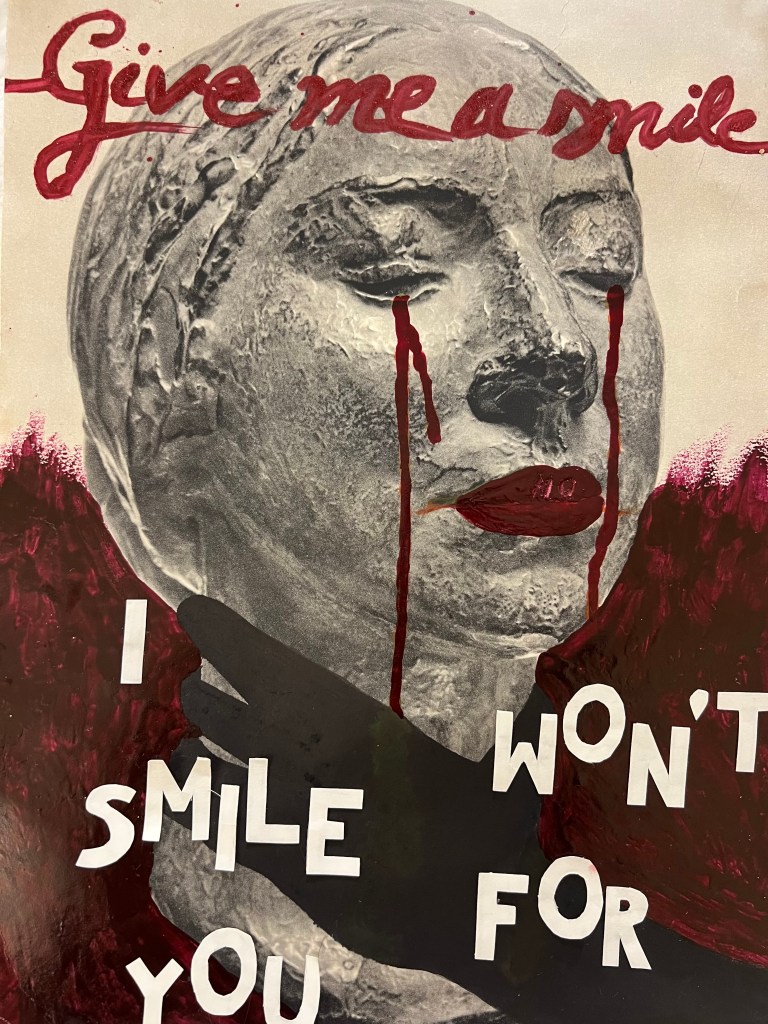
Emily Brown’s Original Artwork – GIVE ME A SMILE (submitted for RIOT!)

 The Creator